
SZTE Researchers Take Major Step Toward Industrial CO2 Utilization
Globally, the electrochemical conversion of carbon dioxide is attracting growing interest from both researchers and industry
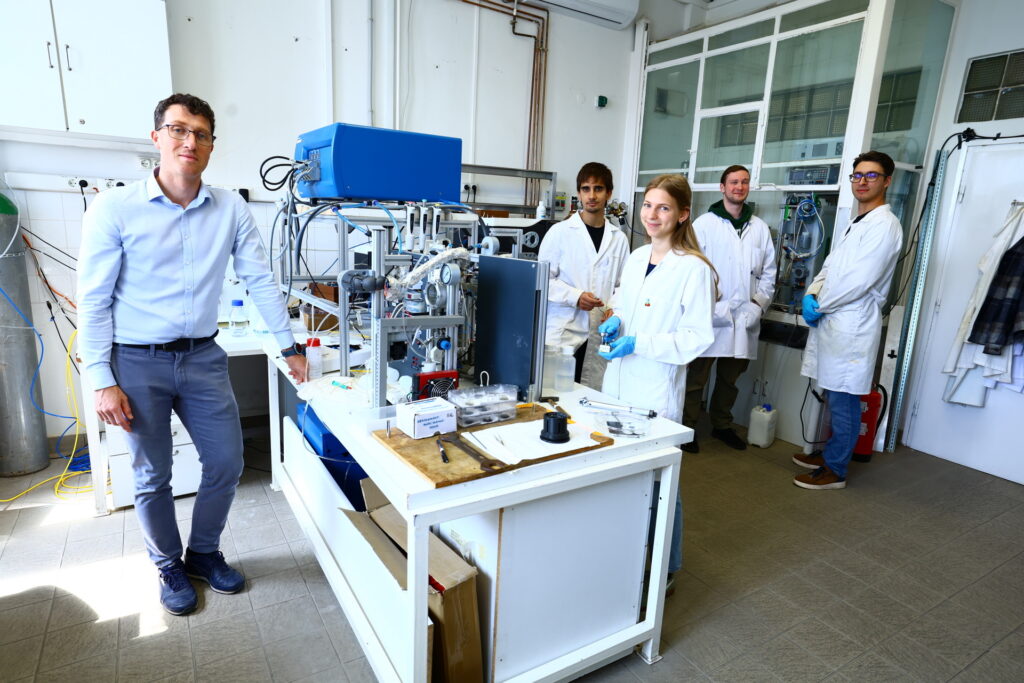
A newly launched HU-RIZONT-supported research project at the University of Szeged could open up new possibilities for transforming industrial carbon dioxide emissions into valuable raw materials. At the heart of the initiative is the development of gas diffusion electrodes for CO₂ electrolysis that can operate reliably and maintain long-term stability.
Globally, the electrochemical conversion of carbon dioxide is attracting growing interest from both researchers and industry. The reason is straightforward: a technology that can efficiently and reliably convert CO₂ over the long term could make it possible to process this greenhouse gas directly at the point of emission. Such an approach would do more than simply prevent CO₂ from entering the atmosphere – it could also transform emissions into valuable industrial feedstocks, most notably carbon monoxide, a key building block used in a wide range of chemical processes.
A central objective of the project is to develop highly efficient and stable gas diffusion electrodes for carbon dioxide electrolysis capable of operating continuously for up to 5,000 hours. To support this work, researchers at the University of Szeged have been awarded HUF 399,174,676 through the 2025-1.2.1-HU-RIZONT International Excellence Research Cooperation Program, funded by the Ministry of Culture and Innovation through Hungary’s National Research, Development and Innovation Fund.
Although the newly funded research program officially launched on March 1 this year, researchers at the University of Szeged have been laying its scientific foundations for nearly a decade.
“Our work on the electrochemical conversion of CO₂ began about ten years ago at the University’s Department of Physical Chemistry and Materials Science under the leadership of Csaba Janáky. We built everything from the ground up – developing our own systems and electrolyzer cells while also contributing to the broader scientific understanding needed to advance the field. Our first major breakthrough came when we became the first team in the world to develop and operate a stable multilayer electrolyzer architecture. From there, the next step was to establish methods for long-term operation and achieve performance levels that surpassed previously reported results. Another key milestone was the development of experimental systems that allow us to monitor the process over thousands of hours while keeping every parameter under precise control,” said Balázs Endrődi, the project’s scientific lead, summarizing the team’s progress so far.
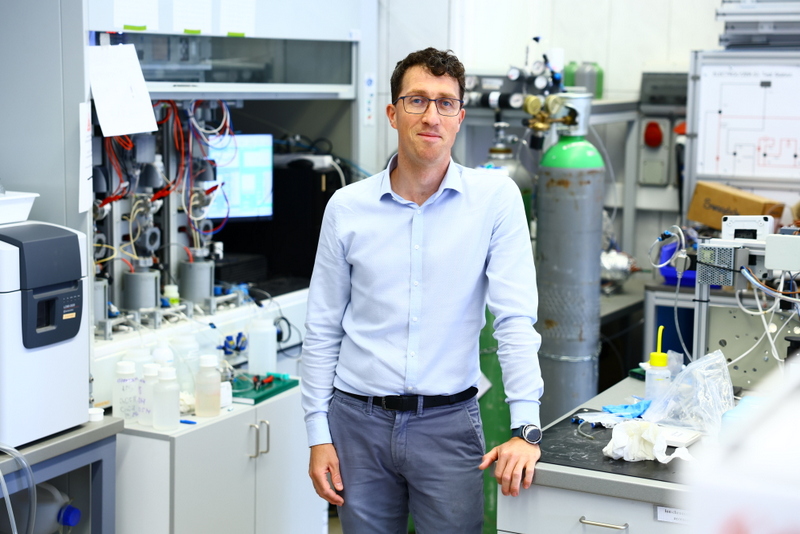
One of the greatest challenges in CO₂ electrolysis is achieving long-term operational stability. For the technology to become truly viable in industrial settings, the current duration of continuous operation – which remains limited to only a few thousand hours – must be extended significantly. That is why one of the main objectives of the three-year research program launched at SZTE in early March is to determine how the structure of the cathode influences both performance and durability, and then apply that knowledge to develop more advanced electrode designs.
As part of the project, the Szeged research team will investigate several promising electrode concepts, including self-supporting catalyst layers and catalyst layers deposited directly onto ion-exchange membranes. The researchers will also examine how key structural characteristics – such as catalyst-layer porosity and incorporated polymer additives – influence the performance of CO₂ electrolysis. Ultimately, the goal is to translate these structure–performance relationships into next-generation electrodes capable of operating continuously for at least 5,000 hours at industrially relevant current densities and with the level of energy efficiency required for real-world applications.
“Our newly launched project is strongly practice-oriented, and its success could directly influence how industry recycles and utilizes CO₂. It is easy to understand why this field is attracting so much attention worldwide. Beyond its clear environmental benefits, the technology could also provide a major incentive for industrial emitters: instead of paying carbon taxes, they may be able to convert carbon dioxide into a commercially valuable product. As with our previous work in this area, we plan to share our most important findings as the project progresses, and the first publication may appear as early as this year. By the end of the project, we expect to have built a knowledge base that can provide tangible value for industrial partners and help bring the technology closer to real-world application,” Balázs Endrődi concluded.
Behind the project stands a strong institutional innovation ecosystem at the University of Szeged. The development of project concepts within the University’s Center of Excellence for Interdisciplinary Research, Development, and Innovation (IKIKK) – including the CRUTCHES project (Gas Diffusion Electrodes for Electrochemical Carbon Dioxide Conversion) and the preparation of its grant proposal – was coordinated by the University of Szeged’s Directorate-General for Strategy and Development in collaboration with its cluster management team. Their work helps transform promising scientific ideas into competitive international projects with the potential to shape the future of sustainable industrial innovation.
Source: University of Szeged, press release, 2026-05-22.